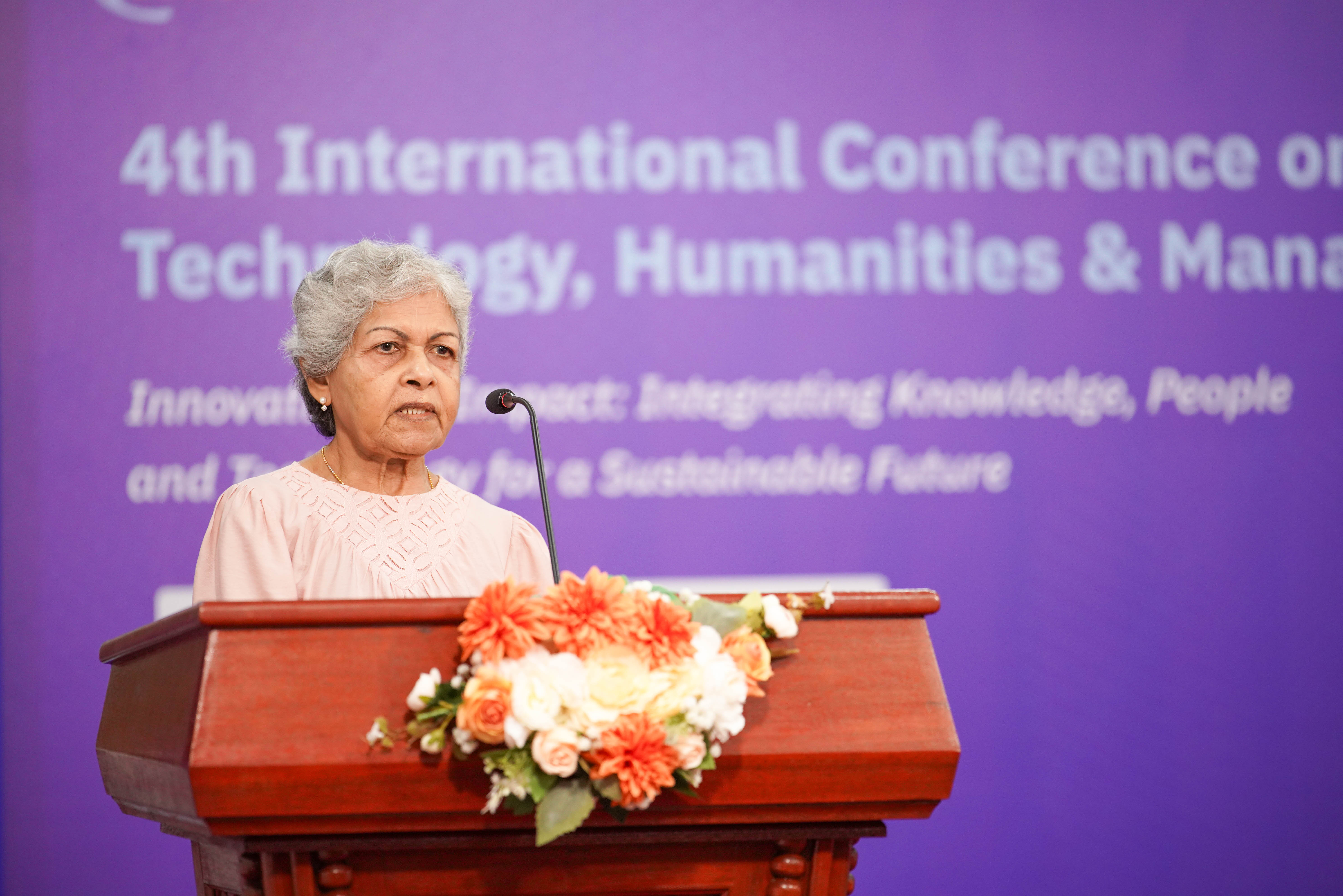
Conference Chief Guest, ICTHM 2026
بسم الله الرحمن الرحيم
Mayor of Fuvahmulah City, Hon. Ismail Rafeeq, Rector Mr. Ahmed Nafees and the Management of Zikura International College, Members of the Organizing Committee, Esteemed Scholars, Panelists and Keynote Speakers, and most importantly, the students and researchers who are the architects of our future, Assalaam Alaikum.
It is my profound honor to stand before you for the International Conference on Technology, Humanities and Management 2026.
To be back in Fuvahmulah an island of such unique spirit and serenity and witness the rising tide of intellectual curiosity among our youth is a privilege I hold dear.
Since its inception in 2014, Zikura International College has evolved from a local institution into a beacon of regional opportunity. With your modern campuses here in the south, you have shifted the very landscape of our tertiary education.
We meet at a pivotal moment. We are currently navigating the transition toward Maldives 2.0 the national vision for a "Digital First Nation." This is not merely a policy catchphrase; it is a structural necessity for a nation of 187 inhabited islands spread across the Indian Ocean. In an archipelago where historically, the sea has been our greatest barrier, digital connectivity is the bridge that finally dissolves the tyranny of distance. Our digital foundation is stronger than ever, now. As of early 2026, our mobile connectivity has reached a penetration rate of 147%, and approximately 85% of Maldivians are active internet users. We have achieved nationwide 4G coverage, with over 85% of the population having access to high-speed fiber connections.
But Maldives 2.0 is more than just raw speed or fiber optic cables; it is about the sovereignty of the citizen in a digital space. It is about a "Smart State" where service delivery is seamless, and economic participation is decentralized. However, as we reflect on the Conference Theme, *Innovating for Impact: Integrating Knowledge, People and Technology for a Sustainable Future*, we must ask: Who are we leaving behind? A digital-first nation is only as strong as its most disconnected citizen. If our progress only benefits those with the latest devices in the capital, we have not built a bridge; we have merely built a faster lane for the few. True inclusion means that our digital transformation must be human-centric, ensuring that technology serves the fisherman in the north and the student here in Fuvahmulah with equal reliability.
While we have achieved nationwide connectivity, we are witnessing a unique Maldivian paradox. In our education system, women are the champions. Female enrolment in tertiary education surpasses that of men by nearly 30 percentage points. Yet, when we look at the labor force, a "leaky pipeline" becomes visible.
The female labor force participation rate stands at roughly 41%, compared to 76% for men. We have broken the barrier to the classroom, but we have yet to dismantle the "digital glass fence." This fence is built from invisible wires: occupational segregation, a 20% wage gap, and the socio cultural weight of being the primary caregivers and that too, unpaid.
In our decentralized archipelago, traditional employment often meant leaving one's island or family a choice that disproportionately impacts women. Currently, on an average, Maldivian women spend roughly 19 hours per week on domestic work, nearly triple the time spent by men. This is where the Digital Dividend must be applied. Digital transformation is not just about faster internet; it is about creating an ecosystem where a degree-holder in a remote island can lead a department via the Gig Economy and Remote Work tools you will be discussing today.
We must redefine what "the workplace" looks like. If a woman in Haa Alif Atoll Dhidhdhoo, for example, can access the same global marketplaces and management platforms as a man in Malé, we aren't just giving her a job; we are giving her back her time and her agency.
We need to leverage digital tools to transition from a model of "presence-based" work to "results based" participation, ensuring that motherhood or geographic location are no longer career-ending variables, but merely different operating environments.
True digital transformation must be inclusive. Roughly 15% of our population about 81,000 individuals remains offline at the start of 2026. These are often the elderly and women in rural islands who may lack the digital literacy to navigate new e-government platforms.
If we do not bridge this gap, "Digital Dividends" will only accrue to the urban elite. We must ensure that eFaas and our new digital payment gateways are as accessible to a grandmother selling short eats in a southern island as they are to a tech CEO in Malé.
Beyond simple access, we must address the "usage gap." It is not enough to have a signal if our citizens do not have the skills to convert that signal into a livelihood. In the context of Maldives 2.0, inclusivity means that our digital sovereignty is shared. We are moving toward a future where "distance" is no longer a disadvantage. But this requires intentional policy subsidizing devices for low-income households, rolling out community-based digital literacy programs, and ensuring that our digital interfaces are intuitive, Dhivehi-language friendly, and culturally resonant.
My years in public service have taught me that Education is a promise, but Opportunity is a policy.
We are moving away from the era of "trial and error" governance. To lead a 21st-century Maldives, we must rely on Evidence-Based Governance.
According to recent global indices, nations that integrate Big Data and AI into public sector decision-making see a 15 to 20% increase in service delivery efficiency.
To the researchers present: Your data is the fuel for this progress. We need you to map the exact intersection of digital literacy and regional unemployment. We can no longer afford to guess where our resources should go; we need to know. When we treat research as the 'pre-policy' phase, we transform governance from a reactive force into a proactive one. We don't just build a bridge because it looks good on a map; we build it because the data shows it will bridge the 35% gap in market access for local island entrepreneurs.
Your papers are the blueprints for the next generation of Maldivian legislation. We need evidence-based solutions to help entrepreneurs.
Our small businesses grow and our legal frameworks adapt to the 2026 landscape. Your work provides the predictive power we need to anticipate economic shifts rather than merely responding to them. By moving from anecdotal observation to analytical rigor, we ensure that every Rufiyaa spent is an investment in a proven outcome. In a small island state with finite resources, the cost of an "uninformed policy" is a cost our future generations cannot afford to pay. Surely, your research acts as our navigational chart, ensuring that as we sail toward Maldives 2.0, we avoid the shoals of inefficiency and the reefs of social exclusion.
We have spent decades building the most beautiful schools and colleges in the Indian Ocean. We have invested billions in our people.
It would be a tragic waste of our Return on Investment (ROI) and a failure of our collective vision if those hard-earned degrees, especially those earned by our high-achieving women, remained only as ornaments on a living room wall. A degree should be a key that unlocks a door, not a certificate of a journey that has reached a dead end.
Let us use this conference to ensure that:
Let us ensure that the "Paradox of the Maldivian Woman" becomes a thing of the past, replaced by a reality where academic triumph is the direct precursor to professional leadership in a digitally-integrated nation. Our intellectual capital is our most valuable natural resource; let us not leave it dormant.
In conclusion, I would like to express once again my sincere gratitude to Zikura International College for this opportunity. It is an honor to be part of an event that so clearly values the intersection of knowledge and national progress.
It is my great pleasure to officially declare open the International Conference on Technology, Humanities and Management 2026.
Thank you.